Friday, May 30, 2014
Magus Magazine: Supernatural Sculpting: The Philosophy of Occult ...
Magus Magazine: Supernatural Sculpting: The Philosophy of Occult ...: Supernatural Sculpting: The Philosophy of Occult Operations Creating the Magick: The Metaphysics of Occult thinking. ...

Supernatural Sculpting: The Philosophy of Occult Operation
Supernatural Sculpting: The Philosophy of Occult Operations
Creating the Magick: The Metaphysics of Occult thinking.
“Poor idiot! Are you so foolish as to believe
we will openly teach you the greatest and most
important of secrets? I assure you that anyone who
attempts to study, according to the ordinary and literal
sense of their words, what the Hermetic Philosophers
write, will soon find himself in the twists of a labyrinth
from which he will be unable to escape, having no
Ariadne’s Thread to lead him out.”
--Artephius
The occult as a source of study has traversed a myriad of philosophical schools of thought. Anthropologists and Folklorists have discussed the implications of magic on socio-cultural and religious levels but have largely shied away from individual agency as part of the occult process. The reason is simple. It is much easier to infer the effect that magic and religion has on a group rather than make speculative guesses on the causal and deterministic motives that the ‘individual’ makes use of. That’s not to say that metaphysical quandaries don’t have a place in occult study. On the contrary, much of what characterizes occult discussion is based on solid metaphysical properties. For example, Jan de Vries has remarked that, “If we view magic as an institutional technique, it does seem that the sprinkling of water causes the rain to appear. But the person who executed this act for the first time did not in the least desire to apply, albeit incorrectly, the law of causality. Primitive man had not come that far at all; He laid hold on the expedient of magic because he found himself in one or another emergency” (176). Even if the causal factor is refuted, the fact that causality is included in a study of magic shows the potency of metaphysical thinking on occult study.
Even Frazer’s work on sympathetic magic had largely causal concerns. It is no surprise that imitative magic makes use of causation as part of their design. For example, the desired effect of manipulating somebody’s personal hair clippings or clothing was to produce a significant effect in their owner. A classic cause and effect scenario. Often times, the experiential nuances of the occult ritual or much more important to understanding occultreasoning than causation or deterministic structure. Famous folklorist Lutz Rohrich has stated that, “The experiential legend depicts numinous astonishment at the apparent suspension of the natural laws of causality in external reality” (26). The shock of witnessing the supernatural becomes an integral aspect of interpreting the magic experience. But is this all there is to occult philosophy? Are there other paradigms that enter into the occult way of thinking?
Whether it is demonic legends, Old Hag, or even UFO abduction narratives, the occult disregards theories accepted in scientific milieus yet is concerned with science. The occult wants to be legitimate. Many occultists strive for the valid deductive argument form: If [theory + experimental conditions + assumptions] then prediction. The problem lays in the fact that many occult and paranormal researchers tend to affirm the consequence of their predictions. For example, a Ufologist might suggest that:
If a UFO, then presence of anomalous lights.
If presence of anomalous lights
Therefore, a UFO.
However, just because there are anomalous lights does not automatically mean there is a UFO present. There obviously could be another explanation. These invalid deductive arguments are more common in studies of paranormal and occult than you many realize. In fact, even some aspects of Ancient Astronaut Theory is guilty of invalid deductive form. It is known that many aspects of AAT make use of highly complex megalithic structures to prove the influence of extraterrestrials on early Man. They postulate that at sites such as Puma Punku in Peru, early Man wasn’t sophisticated enough to design or engineer such an intricate complex. Therefore, aliens must have intervened. The argument tends to take these forms:
If ancient aliens, then highly advanced megalithic structure.
Highly sophisticated megalithic structure,
Therefore ancient aliens.
Or
If highly advanced megalithic structures, then aliens.
Aliens,
Therefore highly advanced megalithic structures.
Although these examples may seem trivial, you can see the complications that arise when attempting to deductively formulate a sound occult or paranormal prediction. However, that’s not to say that the occult is abhorrent to philosophy. On the contrary, there are other philosophical forms that lend a great deal of credence to the occult.
I would lean towards an experiential phenomenalism that relies on some aspects of materialism for its foundation. This theory would postulate that behavior is based upon the phenomenal qualities or interpretations of experience. The mind would provide input based on experiential happenings and determine whatever output or behavior is appropriate. Subsequently, we negotiate phenomenal qualities based upon our perceptions of an experience. And since we are constantly experiencing, we are constantly digesting new input that affects our behavioral output. This would be conducive to memory as well. Past experience would necessarily effect our interpretations of phenomenal qualities thus potentially altering our behavior. For example, if somebody happens upon a UFO, experiential insights are going to be produced by inferring phenomenal qualities as it happens. This person may have never seen a UFO or indeed have no conception of what a UFO is and yet still experience something on account of phenomenal associations. Whether the behavior is awe, bewilderment, or terror, the experiencer’s mental state will change and produce more mental states. The fact that the experience and its phenomenal sensations are occurring and changing in real time as the experience unfolds is why we see multiple behaviors manifest. (i.e. confusion, to fear, to awe)
Much of what constitutes occult and the supernatural involve reality and how we interpret the world around us. Whereas a realist would say that our world is not dependent on human minds for existence, a post-realist philosopher such as Hilary Putnam would assert that the external world is mind and theory dependent. The world is a human construction. He states that, “There is, then, nothing in the history of science to suggest that it either aims at or should aim at one single absolute version of the world” (228). A relativism concerning ontology and truth, what exists and the nature of what exists is relative to society. As we formulate a theory in society, we construct a world. Therefore, all versions of world-making are equally valid. It’s not hard to see how proponents of the occult and investigators of the supernatural would find this philosophy significant. World-making is a relativism that is
community dependent. A pertinent example can be found in the social organization of Malaysia. As part of the social structure that permeates Malaysian culture, magic is a key ingredient in the belief systems and solidarity of the group. Along with socio-political and economic milieus, the magic that accompanies their religious convictions is an integral aspect of understanding Malaysian reality. Although the Western world largely trivializes magic as something anachronistic or archaic pagan debris, for the Malaysians, it is accepted as part of their everyday reality. Because as a society they make the choice to include magical practices, it becomes true and real. As Goodman eloquently remarks, “If we make worlds, the meaning of truth lies not in these worlds but in ourselves—or better, in our versions and what we do with them” (38). By utilizing a social and religious ecology to make sense of reality, Malaysia has found what works for them as a culture.
Another mediation that occurs in occult practice and metaphysical thought can be found in the ‘paradigm of appearances’. Paul Feyerabend uses this ‘paradigm’ to discuss the idea of god in different societies. He remarks that the god that is worshipped in the Abrahamic religions (i.e. Christian, Muslim, Judaic) is ultimately the same God but described differently. A very new-age concept, this God appears to people in different ways but it’s a same reality. God and reality are ineffable and determined by interpretations of appearances. For Feyerabend, reality is pliable and we sculpt the external world. In regards to the Greek Homeric Gods, he concluded that these otherworldly entities were constructed in the same way that modern society constructed the idea of electrons and protons. He remarks that, “If the entities postulated by a scientific worldview can be assumed to exist independently of it, then why not anthropomorphic Gods?” (34) Indeed, why not? If reality is malleable, then all the demons, ghosts, or entities an occultists can conjure is equally valid and real. They take an autonomous existence.
Another example where concepts of appearance and construction can be applied is in supernatural assault narratives. Folklorists have studied accounts of UFO abduction in terms of their morphology and structural similarity to more traditional supernatural narratives. However, much more work could be done with these stories using a study of ‘appearances’ and social construction. For example, for somebody who has had a first-hand UFO abduction experience, their initial impression of the trauma is a legitimate and more importantly, realoccurrence. However, if the abductee comes to realize that the experience was akin to a liminal rite caused by some extenuating circumstance or personal Ordeal, then that impression is equally valid and equally successful. Because reality is ineffable, both impressions are a manifest reality or experiential construction of what exists.
Perhaps what really provides ontological and epistemological credence to occult study is the fact that it can be examined in terms of Actor-Network Theory. Latourian ANT theory makes use of mediations to explain the many nuances that make up a subject. According to Luckhurst, “Actor-Network Theory is the predictive tension between the centered actor and the de-centered network, enabling the critic to move across different scales of explanation” (8). Actor-Network lends itself to the occult so easily because there a multitude of facets that construct the occult. Through the use of translations, transformations, and substitutions, the occult can be re-situated and re-embodied. In what I call the expression of movements, the occult can be made to re-appear in a myriad of forms. These ideas are best illustrated in an example: According to authors, Ruck, Staples, Celdran, and Hoffman,
“A drawing of the 15th century Frater Vincentius Koffsky, a monk of the Danzig order of preachers, depicted himself draining the sacred blood directly from the wound of a Christ crucified as a Tree of Life, with an alchemical oven shown as a temple in the background, marked with the symbols for male-iron, female-copper, and an encircled dot, which is the sign for the final goal, the elixir of drinkable gold, and also a common motif for a mushroom cap; the oven-temple itself also resembles a cluster of fungal caps. The inscription reads: “Now learn naturally and artfully, to draw from this Catholic medicinal fountain of the living water and the oil of joy” (34).
This beautifully described drawing has all the earmarks of occult thought. For example, a quick list might include: a Frater, sacred blood, Tree of Life, alchemy, symbol, Male/Female, entheogenics, the inscription, the occult process. But we can calculate other movementssuch as Catholicism, the fate of the Danzig preachers, the occult in the 15th century, the fate of the drawing, the process of creating the drawing i.e. instruments used to create, and so on. If we centralize the drawing and construct this set of mediations around it in a network, we can use a model of substitution and translation to glean the many meanings in the drawing. I say multiple meanings because the drawing can be re-situated in any number of ways based upon mediations and in doing so, take on any ontological status. It becomes re-created infinitely and enjoys autonomous existence. The drawing then is created and re-created just as in Feyerabend’s ‘paradigm of appearances’ or Goodman’s world-making. It is an entity made real and given meaning through the examination of movements and mediations.
Thursday, May 8, 2014
"Dividing in order to Divine": The Occult Doppelganger
It seems incredible that what our minds produce can affect us
in such powerful ways but it’s true. Sometimes what ‘was’ or ‘is’ are less
important that ‘what could be’. To a magician, what could be is thought of as in the process. It is an intermediary
step between thought and being. The Stoics called it the lekton or expressible. It
is an incorporeal state lacking presence. Without ontological form, it is
liminal or in-between. Just like the middle period during a rite of passage,
when an initiate enters this state they communicate the expressible. In addition, the exchange that occurs between the initiate
and the deity takes the form of conjuration.
This operation or birthing is always more important than how we describe
the process. Origin is not intended to describe the process by which the
existent came into being, but rather to describe that which emerges from the
process of becoming. [1]
During ritual, there is a permanent bond that forms between the
initiate and the deity. Benjamin went so far as to suggest that part of the
creator dies in the ritual process. He states that, “the origin of the great
work has often been considered through the image of birth. This is a
dialectical image; it embraces the process from two sides. The first has to do
with creative conception and concerns the feminine element in genius. The
feminine is exhausted in creation. It gives life to the work and then dies
away. What dies in the master along-side the achieved creation is the part of
him in which the creation was conceived. In its achievement, creation gives
birth anew to the creator. [2]
Although a part of the magician is lost to the entity summoned, in turn the
entity gives something back to the evoker. This something is the gift of
presence. The magician is renewed by having the entity there and present. It is
always the hallmark of a successful occult operation.
Now what do we mean by saying the magician is renewed by
losing a part of himself in the ritual? Only that there is a part of himself
that must be released when summoning the supernatural entity. Artisotle
expressed the idea in his ethos anthropoi
daimon. The usual translation of this phrase is “For man, character is the
demon.” Ethos originally referred to
what is proper in the sense of “dwelling place, habitat.” In addition, daimon means etymologically “to divide,
lacerate.” So daimon was he who
lacerates or divides. We shouldn’t consider this a negative connotation because
only in what divides could the daimon
be thought to destine or thread a fate. So ethos
anthropoi daimon translates into ethos, the dwelling in the ‘self’ or that
which is most proper for him, is what lacerates, divides, assigns, or destines.
In other words, for man to be himself, he must necessarily divide himself.[3] Man must divide and lose a part of himself if
he seeks the presence of an occult entity. But in doing so, he becomes renewed
by having the entity close.
The idea of division isn’t a new concept. Gershom Scholem has
discussed it at great length concerning Jewish prophets in the 13th
century. In his ‘On the Mystical Shape of the Godhead’, he writes of a
cabalistic anthology called the Shushan Sodoth. In this work, prophesy appears
as one’s own doppelganger. The complete secret of prophesy consists in the fact
that the prophet suddenly sees the form of his own self standing before him,
and he forgets his own self and ignores it and that form speaks with him and
tells him the future. As it is necessary
for the prophet to “divide” in order to “divine”, the occultist must also
separate from himself to exact a successful ritualistic interaction. This
separation is also the first state of the rite of passage. When the initiate
divides, he is then ready to enter a liminal time.
The doppelganger is also the difference between actuality and
potentiality or ‘what is’ and ‘what could be’. Potentiality then is the ability
to do something. It could happen. For example, a magician has the ability or
potentiality to perform ritual. But he also has the ability to not-ritualize or
to not pass into actuality. It is these changes from potentiality to actuality
that embody ontological trajectories of the supernatural. To refer again to
Aristotle, the philosopher called it a harmonizing part of nature. He
interpreted actuality (energeia) as
light and potentiality as darkness (skotos).
What is sometimes dark and sometimes light is one in nature.[4]
These stages of light and dark are the perfect metaphor for describing the
liminal. In many societies the liminal initiates considered to be dark,
invisible, like the sun or moon in eclipse or the moon between phases, as the
“dark of the moon.”[5]
Those in the liminal state traverse what is and what could be. Describing the
initiate in terms of light and dark is only a short step from comparing them to
gods or ghosts. It’s essential we understand these various ideas of being when
we attempt to understand critically what is happening during the occult
process.
[1]
Walter Benjamin. Gesammelte Schriften, Vol. 1 Pt 1 pp226.
[2]
Walter Benjamin. Gesammelte Schriften. Vol. 4. Pt 1. pp438. Ed. Rolf Tiedemann
& Maini Suhrkamp 1974-89.
[3]
See Giorgio Agamben’s ‘Potentialities’ for a more detailed account of
Aristotle’s ethos anthropoi daimon.
[4]
Aristotle. 418. B-419 e 1
[5]
Victor Turner. From Ritual to Theatre. PAJ Publishing. New York. 1992.
Friday, April 25, 2014
Magus Magazine: What is the Occult? Identifying The Unseen.
Magus Magazine: What is the Occult? Identifying The Unseen.: What is the occult that many seem to fear and misunderstand? That which is deemed occult – although difficult to define, does have charact...
What is the Occult? Identifying The Unseen.
What is the occult that many seem to fear and misunderstand? That which is
deemed occult – although difficult to
define, does have characteristics that make it at least identifiable. The
concept of correspondences is maybe the most common trait associated with
occult design. Like the Gnostic maxim, ‘As Above, So Below’ the microcosm as
represented by Man corresponds to the universe that is the macrocosm. As Ioan
Couliano remarked, “Before becoming aware of his own possibilities,
man-microcosm finds himself in a universe in which the parties, both low and
high, ‘cooperate’ with each other without his knowledge. At the time he grasps
the structure of that cooperation, the correspondences between the visible
universe and its invisible prototype, he will be able to make use of them in
the service of capturing the unknown presences that lurk in the threshold
between the two worlds”.[1]
In other words, mind and matter cooperate to achieve a desired goal by
corresponding with each other. However,
although mind and its conjurations are one, we are not always aware of the
correspondences. Sometimes they are simply beyond our reach until the
association unfolds experientially. And that’s not to say that the angels or
demons invoked by Man are ‘exclusively’ in the mind. They are also autonomous
entities that have their own personalities and agenda. This idea is a rejection
of ontological dualism. Instead of binary opposition, the occult works off of
benign reciprocity. Entities make
magicians do things. There is work
involved. When a magician constructs a magic circle and an entity appears, both
parties are doing something. The
presence of the entity acts in accordance with the work the magician did in
ritual.

However, occult processes
judiciously negate linear causation as well. This work that is done in ritual-
the complex expressions and original sentiment would never be replaced by
simple, sleight-of-hand utterances of causation under the pretext that former
explains the latter. Instead, occultists present a state of affairs. In the act
of invocation, for example, the magic circle-like a laboratory, construction
site, chef’s kitchen, or theater stage, shows us the consensus decisions used
to create an association. It is the paths taken in the labyrinth to reach a
correspondence. Not only does it lead you backstage and introduce you to the
skills and tracks of practitioners, it also provides a rare glimpse of what it
is for a thing to emerge of our inexistence by adding to any existing entity
its time dimension.[2] In
the construction of an occult interaction, the magician vicariously activates
the signatures of the primordial but not necessarily in a lineal mode of time. What
occurs is a completely unique state of affairs built on correspondence.
Furthermore, this activation
through interaction is another common occult trait. To cause to function,
excite, or react is the utmost goal of the magical rite. Usually the activation
of the ‘Pneuma’ facilitates the interaction a magician will have with an
entity. The Pneuma or “immaterial ether” is the breath of the living god.
Judaic mystics asserted that it was the Pneuma that sparked the primordial air
of Hokmah, then the water and fire of Binah and Hesed on the Tree of Life. And
according to Eilberg-Schwartz, Pneuma denotes air in movement. It can refer to
wind, breath, or life, in the sense of animating power. The Pneuma occurs in the 1st century BCE in
connection with the oracles of Apollo at Delphi: the priestess sat over an
opening in the earth and when she became intoxicated by the vapors that arose
from the fissure she fell into trance, which was interpreted as possession by
Apollo.[3]
The Pneuma is the residing spirit John Dee activated to communicate with
angels. It was the Pneuma that was activated when Aleister Crowley received the
‘Book of the Law’ in 1904. Pneuma is a mirror with two faces , one of which
reflects perceptions coming from the external senses and the other the
phantasmagoria of the soul.[4]
The Pneuma is innate yet when activated an event or surprise. It is a
surreptitious mediator that translates how occultists make their entities do things.

Imagination and Intuition are what
allows the occultist to perceive the many correspondences in their craft. Tarot
readers and astrologers use intuitiveness to interpret divination after Pneuma
has been activated. Both imagination and intuition are forms of perception.
Fantastical reality is part of the real world and it’s these areas of our
psyche that make the jumps and connect the dots during an occult interaction.
There are many ways in which mystics, sages, magicians, and shamans utilize the
imagination and intuitive faculties of the mind to aid in occult practice. Some
tirelessly use meditation in order to awaken areas of the psyche otherwise
unexplored. Visualization techniques are also honed so that focus can be
elevated. For some, lucid dreaming or the use of psychedelic drugs opens
portals in the mind. What they all share, however, is the assertion that the
imagination is not simply flights of fancy or unimportant debris of the
conscious self. The imagination is something unique, mysterious, and
transcendent.

Occult doesn't define a reality. It
was never meant to. It is a translation or movement that shows us a reflective
state of affairs. It is paths taken to reach a precedent or circumstance. This
reflectivity is reflective of occultists themselves. This is the reason why the
mirror has long been an enduring occult tool. Supernatural folklore is also
full of mirror narratives as portrayed in folktales such as Snow White or in
legends like Bloody Mary. Renaissance magician Marsilio Ficino wrote that
menstruating women who look at themselves in the mirror leave little drops of
blood on its surface.[5]
And its been long thought the soul is connected to its reflection in a mirror
and that‘s why breaking a mirror is bad luck. The mirror is a mediator between
the microcosm and macrocosm. It is a portal between realities. After all, if
the whole of reality is infinite and universal, then Man(the microcosm) must
also be infinite and universal. And since experience shows that the body is
neither infinite nor universal, there must be in Man ‘something’ of the
infinite and universal. The reflection cannot differ from that which the mirror
reflects. [6]
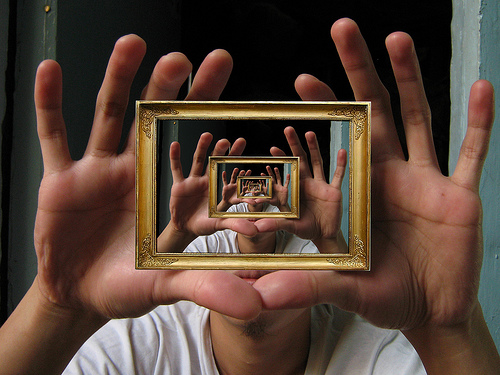
The mirror is also brutally honest.
Reflections don’t lie and for may occultists, reflections in a mirror are a
metaphor for their own spiritual progress. If they perceive a reflection that
is cloudy or if the soul is not sufficiently clean, the individual can be
reduced to a lower, almost bestial state. Then it is a matter of polishing the
mirror, removing its impurities-restoring to the clouded spirit its original
transparency as well as its purity, flexibility, and hardness. [7]
Plato associated mirrors with the Pneuma itself. He stated that, “using the
senses [spirit] grasps the images of external bodies; now, the soul itself
cannot perceive these images directly, given that incorporeal substance,
superior to that of the body, cannot be induced by the latter to receive
images. Omnipresent in spirit, the soul can easily contemplate images of bodies
reflected in it as in a mirror. It is through these images it can appraise the
bodies themselves.”[8]
Although the body cannot directly perceive the Daimonic world due to our meaty
matter state, the soul or Pneuma is free to reflect on this unseen world and
perceive it as in a mirror’s reflection.
The occult is much more than a
collection of spells designed to conjure demons or gain access to the spirit
realm. The concept has evolved. The word now acts as a canopy
for all manner of the strange and inexplicable. Although ceremonial magic may
be the centerpiece of the occult altar, the word also evokes ufology and paranormal studies. Nowadays, the occult is
both Lam and Old Hag. It is hauntings and Hecate herself. The word has become
intertwined with the supernatural and the two are in many ways one and the
same. The fact that the occult has transformed tells us that it has undergone
its own rites of passage. Just as initiates go through changes of status during
supernatural events, the occult has also experienced a change in ontological
state due to ritual processes.
[1]
Ioan A. Couliano. Eros and Magic in the Renaissance. Univ. of Chicago Press.
1984.
[2]
Bruno Latour. Reassembling the Social. Oxford Univ. Press. 2007. pp 89.
[3]
Howard Eilberg-Schwartz. The Savage in Judaism. Indiana Univ. Press. 1990. pp.
104.
[4]
Ioan A. Couliano. Eros and Magic in the Renaissance. Univ. of Chicago Press.
1984. pp. 130.
[5]
Marsilio Ficino. Amore. VII, 4.
[6] A.
Heller. 1967/78/ Renaissance Man, Trans. R.E. Allen. London: Routledge
Publishing. Pp417.
[7]
Couliano Ibid pp. 130.
[8]
Plato. Symposium. VI, 6.
Monday, April 7, 2014
Representation and Re-Presentation of the Occult Mind
The occultist is a savage. That’s not meant in any mean or
disparaging way. The occultist is like primitive man, largely an invention. We construct what we think they were like. But it’s a paradox.
Scholars instruct us to make a “picture” even as they warn us not to make it
up. [1]
Perhaps we have no idea what premodern occultism was like. It’s our best
guess. Savagery unhinges the opposition
between mimesis, a discourse of imitation and poiesis, a discourse of
invention. For example, when we
construct a wax figure of our favorite deity, the creation is only a
representation of the actual entity. But if we then imitate that creation, the
wax figure becomes the original and we are now the representation. The
creation becomes the original and autonomous of us. Even the simple act of
observation consists not in any reflecting on an entity but in the unfolding of
spirit in an entity.[2]

Much of the occult focuses on these areas of presentation and
re-presentation of the initiate and deity. This is because the rite of passage affects
both. Representations: as described by the occult arts include the ideas,
beliefs, and iconography of the occult on our minds. Mental representations
such as emotions, memory, and the subconscious are all effected by occult
interaction. But that’s not to say that the occult experience is only in the
mind. Representations occur in relation to environment. In this way, the mind
extends beyond the brain and the bounds of an individual.[3]
We see this in magic writing such as curse tablets or ritual paraphernalia. A
tablet inscribed with magic lettering serves the same function as a spell
spoken aloud because the lettering triggers mental representations in those who
read it. This is an aspect of its communal nature. But although mental
representations arise in the interaction of embodied brains with the
environment (which also includes other brains), this in no way makes the
distinction between mental and public representations irrelevant.[4]
After all, how we experience mental representations is done on an individual
level. As Dr. Sperber and Deirdre Wilson remark, “people do not simply transfer
representations from mind to mind; communication instead involves active
inference and reconstruction by the receiver.”[5]
But how we receive and infer the occult representation is
largely a matter of interaction and intentionality. Ancient savage philosophers
inferred that every man had a life and a phantom.[6]
For a representation to take form, we must accept that this part of ourself,
this phantom or doppelganger can be interacted with. EXAMPLE Also, for something to be intentional, we
must acknowledge a choice between several alternatives. Our intention must be
to choose to accept that the occult reality- an alternate reality- is
legitimate. This reality as shared by religious specialists the world over is
another part or dimension of reality as a whole.[7]
We are able to tap into alternate reality in a number of ways. Lucid dreaming,
ritual trance and psychedelics are all ways to tap into the this realm of the
Other.
A pertinent example can be found in the rites of ancient
Egypt. Initiates first went through a purification ceremony which readied them
for their ultimate becoming. When nighttime came, the initiate was dressed in a
linen robe never previously worn. Then the priest took him by the hand and led
him to the remotest part of the sanctuary. The neophyte was probably shown
statues that were concealed from the gaze of ordinary followers. The ritual
then enacted the change of status that corresponded with becoming the deity.
This moment occurred in the middle of the sanctuary. A platform was set up
which the initiate mounted, this time in an embroidered linen robe. When the
curtains were drawn, he was revealed like a statue, crowned with palm-leaves
and armed with a torch, for the admiration of the faithful, who filed slowly
past his feet. [8]
The initiate is presented anew and holds a different ontological status from
before. They have become like the deity.

However, transition states lead to re-presentation of the
deity as well. After all, ritual is an interaction. In the past, the deity
enjoyed a central place in this interaction. In fact, non-humans had a central
place in theology, in spirituality, in rituals, and of course in art which they
have almost totally lost.[9]
Nowadays, a crisis of representation has nearly left the deity completely out
of the ritual. Uncertainty about how to interact with these non-humans has led
many religious systems to forget their presence entirely. Moreover, sometimes
the deity itself is ignorant of its own rite of passage. Erigena discussed
divine ignorance in the 1800s when he stated that there is a kind of ignorance
of God, inasmuch as he may be said not to know what things he foreknows and
predestines until they have appeared experientially in the course of created
events.[10]
Just as the initiate must undergo a rite of passage that confers a new state of
consciousness, so too the deity must wait until events play out in order to
know what the ritual accomplished. Also, if the gods are ignorant of things not
yet manifested by their own action and operation, they hold these
potentialities within themselves.[11]
Just as man has nascent potential that must be unlocked through ritual, so too
the deity is changed by what is manifested through the rite of passage.
Furthermore, sometimes man himself is the catalyst for
awakening potentialities in the deity. Carl Jung once remarked that the one
primarily in need of redemption is not man, but the deity who is lost and
sleeping in matter. Only as a secondary
consideration does he hope that some benefit may accrue to himself. His
attention is not directed to his own salvation through God’s grace, but to the
liberation of God from the darkness of matter.[12]
Ritual interactions are the most successful when both the
operator and the non-human connect personally. I don’t mean pure
anthropomorphism although the deity may take on human qualia. I refer to a
metaphysics of presence that functions as a foundation for Being. This gift of
presence is consciousness. And it is this presence, this re-presentation, that
forms the fabric of successful occult ritual.
In the work of occult trajectories, the re-presentation of
gods are a form of ritual economy. The rite of passage involves man and the
deity. The gods do not just appear and then replicate themselves autonomously
through being ‘attention grabbing’. Rather, the immortals need organized help.[13]
During the rite of passage sequence, the deity and man exhibit a ritual
exchange of goods and services. But it is man that performs the high-cost
activities of conjuration. It is man that does the dancing, and singing, and
trance exploration. Most importantly, it is usually man that instigates the
rite of passage. The deity will come along for the ride but its man’s gift of
presence that re-embodies the deitic mind.
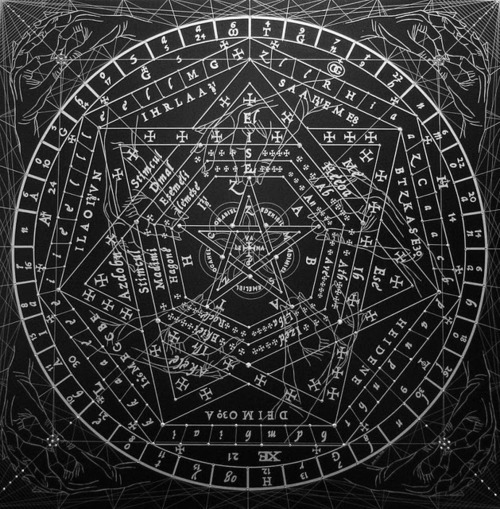
This is what most grimoires fail to teach their devotees.
Discussing non-humans is much more than summoning and banishing. It’s much more
than trance or possession to glean spiritual answers. And anthropomorphism is
only the beginning of this savage philosophy. Non-humans have not been emerging
for eons just to serve as so many props to show the mastery, intelligence, and
design capacities of humans or their divine creations. They have their own
intelligences, their own design, and plenty of transcendence to go on, that is,
to reproduce.[14]
Although non-humans hold humanlike qualities or tendencies, they are autonomous
entities that have their own trajectory and hold their own agenda. Attributing
only anthropomorphism to deity production is like trying to play a three-note
guitar chord with only two strings. Although there is a familiarity with the sound,
something seems missing. This something is evolutionary and experiential.
Just like biological organisms, there is an evolution of the
supernatural. Deities that are fittest or created with a favorable evolutionary
trait tends to be more successful over time. The others fall into oblivion or
are assimilated into another deity. Some genetic variances may shift as in the
case of the Holy Tree. According to the “Golden Legend”, the true cross came
from seeds from the ‘tree of mercy’ in the Garden of Eden. These three seeds
were placed in the mouth of Adam’s corpse by Seth. After many centuries, wood
from the tree was used to build a bridge crossed by the Queen of Sheba on her
travels to meet King Solomon. When she walked across the bridge, Sheba was said
to be struck with a powerful urge to worship. Upon reaching Solomon, she told
the King about the experience. He became terrified of the portent and had the
timber buried. But, fourteen generations later, it would be wood from this
bridge that made up Christ’s crucifixion cross. The narrative shows how
non-humans have an evolutionary trajectory. The tree changed from a seed, to a
tree, bridge, cross, and ultimately holy relic. There are also implications of
birth, maturation, and death in the story. The holy wood went though changes in
status as it changed in form. It has been re-presented a number of times but
every devotee who uses the cross in modern ritual continues to renew its
potentiality.
Occult representation makes use of an entire network to give
meaning to the rite of passage. Again something the grimoires fail to mention.
A successful occult interaction involves not just the entity and operator but a
host of other determinate factors. The network consists of the magic circle and
all its components, the time, place, and context of the rite. It involves the
candle makers and their process of creation as well as any and all group
affiliations the operator may have. Is the operator a Freemason? What kind of
ink was used in the drawing of the sigils? Where does the rite derive from? Was
it appropriated from an earlier ritual or incarnation? What gods were used?
What were their ontological trajectories? Was the liturgy written on papyrus?
Bound in sheepskin? When? These are just some of the questions that the occult
practitioner must address before attempting to re-present the demon or deity.
This is because there are a myriad of mediations or circulating references that
determine the components of the rite.
[1]
Christopher Bracken. Magical Criticism. Univ. of Chicago Press. 2007. pp5.
[2]
Walter Benjamin. Selected Writings Volume 1, 1913-1926. Ed. By Marcus Bullock
and Michael W. Jennings. Cambridge. MA. Harvard Univ. Press. 1996. pp. 151/166
[3]
Andy Clark and David Chambers. The Extended Mind. Analysis 58 (1), 7-19. 1998.
[4]
Ilkka Pyysiainen. Supernatural Agents. Oxford Univ. Press. Oxford. 2009. pp.
45.
[5]
Dan Sperber and Deirdre Wilson. Relevance: Communication and Cognition. Harvard
Univ. Press. 1988.
[6]
Ibid Pyysiainen.
[7]
Felicitas D. Goodman. Ecstasy, Ritual, and Alternate Reality. Indiana Univ.
Press. Indianapolis. 1988. pp. 7.
[8]
Robert Turcan. The Cults of the Roman Empire. Blackwell Publishing. 1996.
[9]
Bastaire & Bastaire 2004.
[10]
Scotus Erigena 1838. 594c
[11]
Ibid
[12]
Carl Jung. Psychology and Alchemy. Trans. By R.F.C. Hull. Bollingen Series XX,
Vol. 12 Pantheon Books. New York. 1968.
[13]
Journal of Royal Anthropological Institute. 4 (11) March 1988. pp. 129-132
comment.
[14]
Bruno Latour. Will Non-Humans Be Saved? 2009
Wednesday, March 12, 2014
Magus Magazine: Savage Occult: Rites of Passage and Durkheim’s fal...
Magus Magazine: Savage Occult: Rites of Passage and Durkheim’s fal...: Savage Occult: Rites of Passage and Durkheim’s fallacy The Savage Occultist or Post-Modern Prometheus experiences the r...
Subscribe to:
Posts (Atom)