Tuesday, October 8, 2013
Magus Magazine: The Savage as Post-Modern Prometheus
Magus Magazine: The Savage as Post-Modern Prometheus: How do we explain premodern occultism? There has been much work on the subject from the 17 th century into modern day but premodern occult...

The Savage as Post-Modern Prometheus
How do we explain premodern
occultism? There has been much work on the subject from the 17th
century into modern day but premodern occultism is largely an examination of
religious ritual. And this makes sense. The two were intertwined and much of
early socio-religious organization was based on finding anthropomorphic or
humanlike ‘recognizable’ characteristics in both natural and supernatural
ecologies. Much of academia jeers this tendency but the premodern Savage
understood representation and how to construct being maybe better than we do
today. When they designated something or imbued something with recognizable
traits, they gave it existence. This made language something very powerful. As
Bracken has remarked, “language is the incalculable event of a being’s
emergence into being”. [1]
When the savage said the name of something, it was enough to invoke it into
their presence.

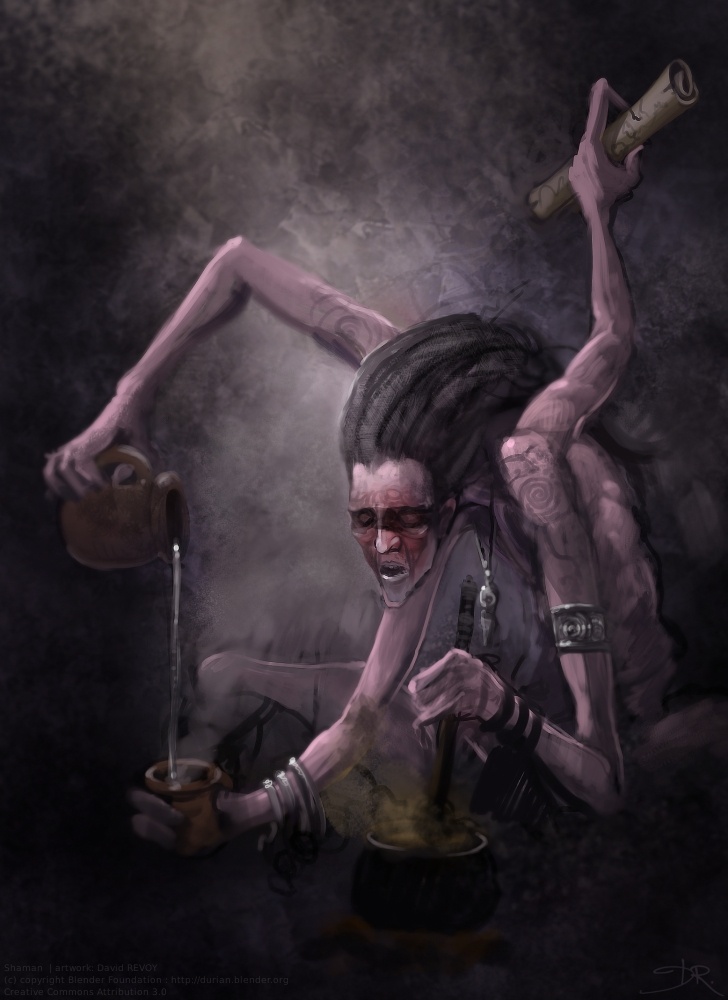
The occultist is a Savage. I don’t mean
that in any mean or disparaging way. The occultist is like primitive man, largely
an invention. We construct what we think they were like. But it’s a paradox. Scholars instruct us to make a “picture” even
as they warn us not to make it up. [2]
Perhaps we have no idea what premodern occultism was like. It’s our best
guess. And mainstream academia has no
room for occultism at the table. We cannot rely solely on artifacts, ritual
paraphernalia, and other material culture because archaeology doesn’t have the
time or inclination to differentiate occult practice from any other ritual
behavior. Furthermore, as Karl Bucher
correctly surmised, anthropology’s “picture” of savagery unhinges the
opposition between mimesis, a discourse of imitation and poiesis, a discourse
of invention. Our favorite fetishes are
examples of this. When we construct a representation of Ra-Hoor-Khuit, the
creation is only representation of the actual entity. But if we then imitate
that creation, Ra-Hoor-Khuit becomes the original and us now the representation. The creation becomes the original and
subsequently “lives.” It is a method of
conjuration that then is autonomous of us. As Walter Benjamin stated, “to
observe a thing, means only to arouse it to self-recognition. Magical
observation consists not in any reflecting on an entity but in the unfolding of
spirit in an entity”.[3]
What the post-modern Savage knows
instinctively is that occult practices are about potentialities. The method
makes use of what can potentially come to
pass. The ritual is one of completion. Just as the four corners of a magic
square signify completion, the latent potentialities in the ritual are the
source of its true self-evidence. As Georgio Agamben states, “potentiality is
not simply non-Being, simple privation, but rather the existence of non-Being,
the presence of an absence. “[4]
Embedded within the potentiality of absence is the entity’s eventual becoming.
All ritual is interaction and the
Savage knows this. Or more specifically, the “quality” of the interaction. When
we realize the numinous, we elicit a transformation. It’s something we feel. It is in the shock and awe that transformation
happens in us. And it’s easy to undervalue what this means. It’s easy to
perform a ritual and exclaim afterwards, “I feel changed!” or “I’ve been
transformed!” But when somebody really does witness a numinous event, the idea
of terror moves from conceptual to experiential understanding. It is
realized. This form of occult
understanding includes a new “awareness” of the phenomenon. It is the kind of
awareness we get when somebody jarringly enters a room that we’ve been alone in
for hours. It’s unnerving when Being is made Present. This is important to the
post-modern Savage. At the moment that our spirit entity shifts from a
conceptual to an experiential event, they undergo an ontological change of
state. They become present. And having these entities present gives us the
interaction needed to empathize with them. We can bond with them. We feel
instinctively the truthfulness of somebody when they say, “I understand you” or
“I share your feelings” because we feel the sincerity of the statement. We are moved by this kind of talk. If done
right, occult ritual also leads to this bonding that makes an entity present to
us. The interaction happens when the numinous
transforms us. It may be jarring or perhaps even terrifying but this
gift of presence is of good “quality”. The interaction has been successful. It
is being aware of a relationship and it carries a message of mutual empathy.
Moreover, this interaction doesn’t require that these entities have human
emotions or desires. Nor does Man need have their ambitions or agendas. All
that is required is an empathetic bond instilled when the veil is torn asunder
by being brought closer.
The occultist is a Savage and his
methods an end to normal sensibilities. He is thought to live in a dreamworld.
He sleepwalks in daylight. His personifications are all too human. He is
tragically flawed and incapable of metaphor. His thinking is like a child. He naively
confuses associations of symbol with real life. He sees people on TV and thinks
they’re real. Characters in books are conjured. He is noble and he is honorable
but he is dim. He believes his creations are both constructions and autonomous.
He believes that things can be made by Man and God. He is hopelessly animistic.
He believes in a second real world. He cannot separate real from the ideal. He
cannot be socially civilized. He is a dreamer. We could teach him but can he be
taught?
These are the common
representations of the Savage thinker. A dreamer out of touch with reality.
Somebody the enlightenment forgot. In actuality, the violence inflicted on the
Savage is a gross caricature. But we’ll embrace these pictures of us. We’ll
hold on tight and like Prometheus allow ourselves to be chained to a rock. The ‘civilized’
are free to feed on our liver. We delight in it! It was us that thought to
steal actualizing energy (energeia) from nature (phusis) and grant it
unlawfully to discourse (logos). [5]
It was us that first experienced the gods and goddesses. The so-called
civilized will remember us as their creations come of age. The electronic era
will remember the Savage and we will be renewed once again as their creations
discover autonomy. The Savage is a
dreamer. We are no difficult to Western Civilization as “it finds itself
between dreams. In the true meaning of the word, it is a time of crisis-with
all that implies of both extraordinary danger and opportunity”.[6]
The Savage is in-between dreams. We live a liminal existence between yesterday’s
premodern and tomorrow’s postmodern thought. It’s now time for the so-called civilized to
witness the Savage and our spectral world as we are re-embodied through
interaction.
[1]
Christopher Bracken, Magical Criticism. University of Chicago Press. 2007. pp. 21
[2]
Ibid pp. 5
[3]
Walter Benjamin, Selected Writings Volume 1, 1913-1926. Ed. By Marcus Bullock and Michael W.
Jennings. Cambridge. MA. Harvard Univ. Press. 1996. pp. 151/166
[4]
Giorgio Agamben, “On Potentiality” In Potentialities: Collected Essays in
Philosophy. Trans. Daniel Heller-Roazen. Stanford Univ. Press. 1999. pp. 179
[5]
Jean-Luc Nancy, “Myth Interrupted,” In The Inoperative Community. Ed. Peter
Connor, Lisa Garbus, Michael Holland, and Simona Sawhney. Minneapolis: Univ. of
Minnesota Press. 1991. 45,I 6 I n 2 I
[6]
Jacob Needleman, A Sense of the Cosmos. New York. 1975. pp. 1-9
Thursday, August 29, 2013
Magus Magazine: Blood taboo, the Serpent and the Shroud: Folklore ...
Magus Magazine: Blood taboo, the Serpent and the Shroud: Folklore ...: One of the most popular motifs of occult folklore is blood. Traditionally, blood is a symbol of purity and fertility. In some ceremon...
Blood taboo, the Serpent and the Shroud: Folklore of revulsion

One of the most popular motifs of
occult folklore is blood. Traditionally, blood is a symbol of purity and
fertility. In some ceremonies, water is substituted for blood but the idea of
blood and the chalice is a paramount occult teaching. Anybody who has read ‘The
Da Vinci Code’ recognizes the importance of blood in esotericism. Although a
pop culture phenomenon, which, incidentally makes most occultists howl in
disgust, the idea of Sang Real or ‘Holy Grail’ as the womb of Mary Magdalene is
a much older initiatory teaching. The holy bloodline of Christ is an oral
narrative has been passed down in the recesses of secret society membership for
hundreds of years. Tarot symbolism also preserves this secret and anybody who
has studied the cards knows of the importance of the suit of cups and its
relation to blood.

Moreover, the etymology of blood is
ripe with esoteric connotations. According to Judy Brahn, “Old English forms
related to blod, ‘blood’ are blowan, blew and blown, meaning ‘to bloom, to
blossom.’ In French, fleur means ‘flow’,
and fleurs, ‘flowers’.” (Judy Brahn. Blood, Bread, and Roses: How menstruation
Created The World. Boston. Beacon Press. 1993)
And therein lays one of the mysteries of the original Rosicrucians. The
red rose is much more than a flower. It is the flowing of sacred blood. It is
blooming and the vessel that carries the
godhead into this world.
Red hair was also a symbol of
blood. The Malleus Malifacarum asserted that red hair was a sign of a witch.
Again, this superstition dates back to the taboo associated with menstruation.
Menstrual blood is considered polluting or toxic. As Ambrose Pare remarked, “a
child conceived during the menstrual flow takes his nourishment and growth…from
blood that is contaminated, dirty, and corrupt”. (On Monsters and Marvels-
Translated by Janis L. Pallister. Chicago. University of Chicago. 1983)

Poisonous blood also leads to the metaphor of snakes or ‘serpent’. We all know the theological importance of the serpent in the Bible. And we’ve all seen the auroboros image and are familiar with Medusa in Greek myth. But how often do we ask ourselves what these symbols mean? It’s strange to relate snakes and blood with Time but it’s probably the most appropriate meaning of the representation. Janis L. Pallister reiterated the idea when she stated, “Indeed, we have seen that association between feminine blood and snakes implies cyclic renovation on the model of moon revolutions.” (Archaeology of Intangible Heritage. Chicago. Univ. of Chicago Press. 198
Perception
of the occult is one of filth and revulsion. The reason why is because many of
its tenets are misconstrued as perversions of traditional Christian ethos. For
example, the mirroring of sacrificial and menstrual blood is something the
occult has been teaching for centuries. Modern Christianity- especially
Evangelical denominations- consider this concept absolutely horrifying. It is
more than repugnant; it is blasphemous.
But the folklore behind such thought is very spiritual. When Even
partook of the red fruit, the apple
of folklore, menstrual blood and thus Original Sin was introduced into
creation. Christ’s redemption of this
curse is with the spilling of sacrificial blood. When Jesus chooses to sacrifice
his holy blood he chooses menstrual blood as a vehicle for redemption. As
Colledge and Walsh remark, “the incarnate godhead redeems humankind by opposing
the blood of Mary to that of Eve, and sacrificial bloodshed to menstrual
bleeding” (200- Edmund Colledge and James Walsh, ed. Julian of Norwich:
Showings. New York 1978. Paulist Press. ). For somebody who doesn’t understand
that Eve’s folly and Mary’s purity are mirror-image archetypes, the idea that
Christ chose Eve’s polluting blood is at best contradictory, and at worst
heretical. Occultists don’t shy away from this idea. Those that use menstrual
blood in their Eucharist cakes or in other forms of ritualization know that
ingesting menstrual blood has bewitching properties. Groups like Kenneth Grant’s
Typhonian Order consider menstrual blood as essential aspect of the ritual
because they know that in its pollution
is purity.

The serpent is also a symbol for renewal. It seems
counterintuitive due to the nature of the serpent and its role in Biblical
narratives. Nevertheless, the serpent shares themes of re-vitalization as well.
In its propensity for cyclic renovation, it is the perfect candidate for
renewal. The serpent’s position as something Trickster or evil is also part of
what Occultists call the veil. It is
the veil that separates Man from his spiritual evolution. It is like a cataract
that covers the inner eye and keeps us blind to the daimonic world around us.
The veil must be sloughed like snake skin. Often times, this shedding of the
past is celebrated ceremonially. For example, Francisco Vaz Da Silva has
studied the House of Shrouds in Iberian folklore. He found that when somebody
who was deathly ill made a miraculous recovery, they would embark on a
pilgrimage to the “Casa des Montalhas”.
He states that “over centuries, those past hope who were healed would
make a point of travelling to the healing sanctuary wearing a shroud or carried
in a coffin. The main idea underlying this custom is that people given up as
dead had come back to life and so would take off the death garb at the
sanctuary in token of resurrection” (152- Francisco Vaz Da Silva. Archaeology
of Intangible Heritage. New York. Peter Lang Publishing. 2008). This sloughing
of the shroud is the equivalent of the shedding of serpent’s skin and symbolic
of renewal as personified in Jesus of
Nazareth. Furthermore, the “Shroud of Turin”-long famous as a holy relic and
artifact of resurrection, can be considered a form of snakeskin. For many,
equating Jesus Christ with the serpent is the vilest heresy but if we ignore
traditional orthodoxy in favor of esoteric ism and folklore of renewal, we have
a very profound message. If we but open our minds to the possibility, then that
solemn image embedded in the fabric of the cloth really is proof that Jesus
slipped the veil and became re-embodied in the spirit. In this sense, the
shroud is not proof of death but of life. And when we look upon the image, we
bear witness to the Dying God mythology. As Jesus undergoes the trials and
tribulations of the sloughing of his former existence, he is in a liminal state
betwixt and between ontological statuses. His being is moving from potentiality to actuality and in doing so, becoming something new.
Friday, August 16, 2013
Should the occult abandon the natural sciences?
SHOULD THE OCCULT ABANDON THE NATURAL SCIENCES?
Here is an excerpt from an upcoming book about the 'Folklore of the Supernatural'
Many take the occult very seriously
and regard it as a real threat to the fabric of society. Perhaps remnants of
the reason-driven war on the occult arts during the renaissance or the
rumor-panic of Satan in our neighborhoods in the 1980s, the occult is a very
feared enterprise. Moreover, academia has trouble finding a category in which
to place the subject. The natural sciences back away slowly at any mention of
the word. The psychologists smirk and identify a dozen neuroses that could
explain any and all of the mystery of supernatural processes. The psychiatrists
simply get giddy. Only the anthropologists and folklorists will explore the
occult in situ and on its own terms. But even then, the subject is a
complicated matter. As Folklorist Gillian Bennett remarks,
The main trouble for folklorists
is that we have got ourselves into not one, but no less than three vicious
circles. Firstly no one will take the subject because it is disreputable, and
it remains disreputable because no one will tackle it. Secondly, because no one
does any research into present day supernatural beliefs, occult traditions are
generally represented by old legends about fairies, bogeys, and grey ladies.
Furthermore, because published collections of supernatural folklore are thus
stuck forever in a time-warp, folklorists are rightly wary of printing the
modern beliefs they do not come across for fear of offending their informants
by appearing to put deeply felt beliefs on a par with chain-rattling skeletons
and other such absurdities. Thirdly, because no one will talk about their experiences
of the supernatural there is no evidence for it and because there is no
evidence for it no one talks about their experiences of it. (1987 pp13 Gillian Bennett. Traditions of
Belief: Women, Folklore, and the Supernatural Today. London. Pelican Books.)
As Gillian has correctly surmised,
the occult is in an academic conundrum. Ironically, much of these questions of
validity and reputability have been grossly perpetuated by occultists
themselves. Since antiquity, the occult processes has been intertwined with
advances in science. For example, as astronomy and chemistry became more
advanced, their occult counterparts in alchemy and astrology lost favor and in
turn, lost validity. But its been the occultists themselves that have continued
to try and make their arts a natural science. For the most part, the scientific
community has been content to leave well enough alone. It s been practitioners
of the occult that have continued to be concerned
with science. It’s no coincidence that famous magus Aleister Crowley named
his particular form of ceremonial magic: Scientific Illuminism.
Perhaps it’s time to leave the
never-ending subdivisions and cul-de-sacs of the natural science community and
venture into the small towns and country of the social sciences. The occult can
be right at home without being concerned with the natural sciences. And that’s
not to say that the supernatural cannot be endowed with a robust philosophy or
even dip its foot into quantum theory and other like-minded scientific
theories. It’s just time for a change. Throughout this book, we will be
venturing into these uncharted and unexpected places. We’re creating a trail
that will be followed by any and all who want a fresh approach to occult study.
Instead of focusing on what can be empirically proven, we will show why its
unnecessary to validate in this matter. Instead of trying to prove the logic
and rationalism of the supernatural, we will embrace a metaphysics based on
experiential happenings. Instead of trying to convince the academic community
of the occult’s relevance, we will let anomalous entities be their own
informants and inquire into how these creatures re-present themselves
continuously. And in so doing, we will re-discover what it means to be an
occultist in the modern world. Like the black hole in the center of a galaxy or
the spider at the center of its web, we will explore the series of connections
and correspondences that make this world and showcase its place in the center
of a truly intricate and delicate network of the numinous.
In ‘Religion, Philosophy, and
Psychical Research’, Charles Dunbar Broad introduced a theory for God’s
existence that had anthropological connotations. In essence, it stated:
1)
People cross-culturally have reported
experiences in which it was seemed to them that they experienced God.
2)
If people cross-culturally have reported
experiences in which it seemed to them that they experienced God, then people
cross-culturally have seemed to experience God.
3)
People cross-culturally have seemed to
experience God.
4)
If people cross-culturally have seemed to experience
God, then there is experiential evidence that God exists.
5)
There is experiential evidence that God exists.
This theory is remarkable cogent
and fits well into anthropological discourse. It is especially good for occult
studies. In fact, if we replace the word God for Old Hag, or Demon, or
Extraterrestrial, we have a workable theory of occult experience. And the fact
that it accentuates ‘cross-cultural’ experience gives it multiple avenues for
social scientific research. It at once gives credence to narratives of the
supernatural while it simultaneously suggests that this sort of phenomenon is
experiential and found in a multitude of cultural scenarios.
What makes this form of occult
study particularly exciting is that it asks us to question what is real based upon what we can empirically
verify. And that’s the rub isn’t it? It’s also the main criticism of Broad’s
theory. If people are seeming to experience God or the Occult, then there must
be some way to test these experiences. In true Popperian fashion, we must find
way s to falsify or verify the experience in the same way sensory input can be
falsified or verified. If we subject the experience to ‘checking’, then what
people seem to experience is not evidence of the reality presented.
Perhaps an elegant way to resolve
this conundrum is through the ‘inferences’. We can
accept the validity of occult experience by inferring their non-causal
properties while carefully recording the causal properties and sensory data
that accompany the event.
We should probably explicate
exactly what we mean by folklore of the occult and supernatural. Typically lore
is transmitted verbally and passed on from person to person via stories. Telling stories is the perfect conduit to
disseminate folklore – especially of the supernatural variety. They provide a
suspense that can’t be matched by reading the account or watching it on
television or at the movies. The face to face interaction requires a personal
exchange. It’s much easier to relay ‘how something seemed’ by being able to
tell it how it happened. And we all love a good story. Whether it be a ghost
story, UFO experience, or banishing ritual, supernatural stories are the best
stories. And we’ll be exploring these various forms of folk belief throughout
this book.
The supernatural is also, more
often than not, believed narratives. There is something about believing the
unbelievable that is attractive to both the storyteller and his audience.
Perhaps due to the exotic nature of supernatural belief, we want to include
these experiences into our worldview. Anybody who has claimed to be a UFO
abductee or seen a ghostly visitor will swear absolutely and without
reservation that what they experienced was real. Most have no doubt as to the
ontological relevancy of these entities. The “I have seen it with my own eyes”
is a popular catchphrase for this type of contemporary legend.
As well as believability, these
narratives also hold structural similarities that make them especially easy to
group together. There are motifs, and morphology that capture what I call
likeminded essences in the
narratives. Moreover, not only are these various contemporary legends similar
but they also echo traditional supernatural assault traditions of the past. In
the stories of fairies, angels, changeling, gnomes and other creatures of the
past are the prototypes of modern myths and monsters. It’s no surprise that the
modern UFO movement is so full of religious imagery. These re-presentations of
the numinous follow society and take on new meaning as times change. But even
though their faces may change or the narratives many show variations in plot or
action, the terror that is evoked surpasses time and space.
Saturday, August 3, 2013
Authentication of the Anomalous Part 1
Here is a small excerpt from a larger work on Rites of Passage and the Occult...Check it out!
Each initiate who undergoes a rite
of passage also undergoes a corresponding change in consciousness. This change
is indicative of the change in status that occurs as part of the experience.
Often times, the change occurs as a time of transition during the liminal
state. Literally a transitional event within the transitional state. Sometimes
this event happens while sleeping. Rothman and Sudarshan remark of this
transitional period in regards to Kashmir Shaivism. They remark that “if one
examines Kashmir Shaivism, one finds
extremely specific instructions for achieving various states of consciousness.
We are first told that there is a junction, or transition point, between each
of the three states of consciousness and the next: the waking state, the dreaming
state and the state of dreamless sleep” ( 18 Doubt & Certainty by Tony
Rothman and George Sudarshan. Reading Mass. 1998. Perseus Books). Proponents of
this form of Shaivism state that, “you should [focus on] the center of any two
movements, every two breaths. After some time when that concentration is
established, then whenever you go to bed to rest you will automatically enter
the dreaming state through that junction…Here you do not lost consciousness
even though you feel intoxicated…Here the aspirant does not experience moving
about nor does he hear or see. He cannot move any part of his body. At that
moment the aspirant hears hideous sounds” (Kashmir Shaivism, the Secret
Supreme. Swami Lakshman Jee. Albany. SUNY Press under imprint of the Universal
Shaiva Trust. 1988. Pp 109).

The transition point is reminiscent
of folklorist David Hufford’s work with Old Hag phenomenon. Often times, an Old Hag event entails the
victim being attacked by a supernatural entity. The victim usually awakes in
the middle of the night unable to move or scream. Then, a horrifying presence
is exerted on his or her chest. (Quote) The Old Hag attack involved complete paralysis
and is associated with night terrors. Like Kashmir Shaivism, the Old Hag experience occurs upon waking from sleep.
During the transition from dream to wakefulness, or from one state of
consciousness to another, the aspirant is in a liminal state and is more
susceptible to the strange or unusual.
Carl
Jung also studied transitional moments of a liminal state. In particular, he
researched the effects of complexes and neuroses when they become conscious. He
wrote that, “it is felt as strange, uncanny, and at the same time fascinating.
At all events the conscious mind falls under its spell, either feeling it as
something pathological, or else being alienated by it from normal life. If the
content can be removed from consciousness again, the patient will feel relieved
and more normal. The irruption of these alien contents is a characteristic
symptom marking the onset of many mental illnesses. The patients are seized by
weird and monstrous thoughts, the whole world seems changed, people have horrible,
distorted faces, and so on” (119- Carl Jung. Psychology and the Occult.
Bollingen Series. Princeton. 1981). As transitional events during a betwixt and
between state, the complex is no longer repressed and allows for experiences of
the Other or Alien.
Changes
in state occur at a ritual level when the rite is used as a proxy for the
mythical narrative. As Walter Otto exclaimed, “ cultic rites were frighteningly
serious because they were concerned with none other than the presentation of
the supernatural occurrence which the myth had expressed in words” (77 Walter
Otto. Dionysus-Myth and Cult. Dallas, Texas. Spring Publications. 1981. Orig.
Published 1965- Indiana Univ. Press). Often times, the occult ritual is the most
important catalyst for inducing a change in consciousness. It is within ritual
that the supernatural narrative can be acted out, grasped and given legitimacy.
Sometimes the climax of the ceremony extracts the numinous in the initiate and
serves as the transitionary event. Such
was the case at the Isaeum in ancient Egypt.

The
Isaeum was the sanctuary and place of ceremonies for the Egyptian goddess Isis.
A physical representation of the liminal state, the initiate separated
themselves from the world of the profane by entering its walls. And this was
serious business in ancient Egypt. When aspirants left the blazing light of the
desert and entered the cool chambers of the Isaeum, it was thought they were
passing from the world of the living to that of the dead. It was in these liminal
spaces that their most important rituals occurred. Robert Turcan describes a becoming rite when the initiate is
transformed into a god. He states that, “the initiate was dressed in a linen
robe never previously worn; then the priest took him by the hand to lead him to
‘the remotest part of the sanctuary’, or penetralia. The neophyte was probably
shown statues that were concealed from the gaze of ordinary followers. In the
middle of the sanctuary, a platform was set up which the new initiate mounted,
this time clad in an embroidered linen robe…When the curtains were drawn, he
was revealed like a statue, crowned
with palm leaves and armed with a torch” (Robert Turcan. 1996. The Cults of the
Roman Empire. Blackwell Publishing Inc. Williston). The transitionary event and
its change in consciousness becomes the focal point of the ritual.
This
state of affairs was common in the mystery cults of the Greco-Roman era. A way
to resolve the immanence/transcendence dichotomy, many of the cults sought to
instill the divine within thus making them immortal. As Jane Ellen Harrison
remarks, “To become a god was therefore incidentally as it were to obtain
immortality. Their great concern was to become divine now” (477-Prolegomena To
The Study of Greek Religion. Princeton Univ. Press. Princeton. 1991).
To Be Continued....
Sunday, July 21, 2013
Magus Magazine: Evolution and Deities Part One
Magus Magazine: Evolution and Deities Part One: Hello everybody! Here is a portion of Evolution and Deities. I'll be adding another bit concering the falsity of Ontological Relativ...
Subscribe to:
Posts (Atom)